
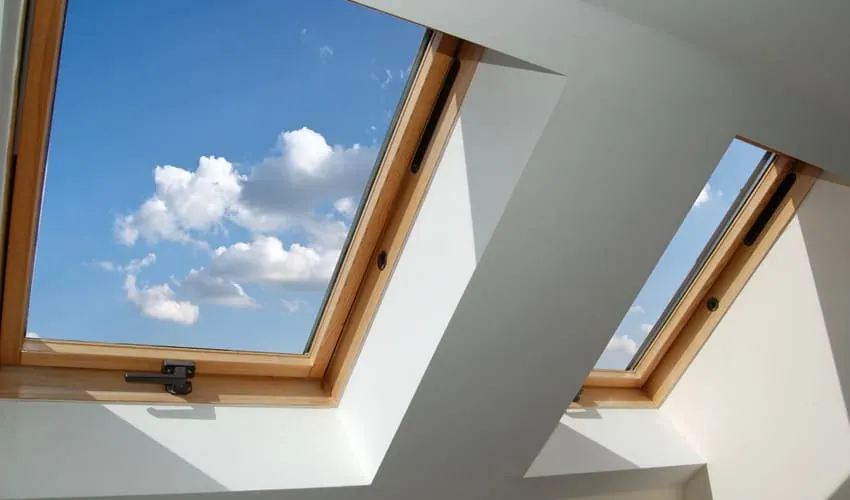
Skylights are one of the easiest ways to bring more daylight into a home, especially in loft rooms, extensions and dark landings. This guide explains the main types, their pros and cons, whether you need permission to fit one, and how to keep one watertight.
What is a skylight?
A skylight is any window built into a roof. Because it faces the sky, it lets in much more light than a wall window of the same size.
You’ll see a few different names used:
- Roof windows sit in the slope of a pitched roof, in line with the tiles or slates. Most open, either by pivoting in the middle or hinging at the top. VELUX is the best-known make, so many people call any roof window a “Velux”.
- Rooflights are usually fitted on flat roofs. They can be a flat glass panel, a raised dome or a glazed lantern, and may be fixed shut or open for ventilation.
- Conservation rooflights are slim, low-profile metal-framed windows designed to suit older buildings and conservation areas.
- Sun tunnels, or light tubes, carry daylight down a reflective tube from a small dome on the roof to a ceiling diffuser. They suit hallways and bathrooms where a full window won’t fit.
- Commercial rooflights, often GRP or polycarbonate sheets, are built into the roofs of warehouses and industrial units.
The pros of skylights
- More daylight. A roof window lets in far more light than a vertical window, which makes rooms feel bigger and can cut down on lighting during the day.
- Ventilation. Opening roof windows let warm, moist air escape from the top of the room, which helps in bathrooms, kitchens and loft bedrooms.
- Makes a loft usable. For many loft conversions, roof windows are the simplest way to get light in without building a dormer.
- Means of escape. Some roof windows are designed and sized as fire escape windows for loft rooms. If yours needs to be one, it has to meet Building Regulations.
The cons of skylights
- Leaks. A skylight is a hole in the roof, so it relies on its flashing to keep water out. Poor fitting is the most common cause of leaks.
- Condensation. Warm, damp air meets the cold glass, especially in bathrooms and kitchens, and older single or double glazing makes it worse.
- Heat. South-facing skylights can make a room uncomfortably warm in summer, and older ones lose heat in winter. Modern glazing and blinds help with both.
- Cleaning and maintenance. Roof windows are harder to reach from outside than wall windows, and seals and flashings wear out over time.
Do you need planning permission for a skylight?
In most cases, adding a roof window to a house in England counts as permitted development, so you don’t need planning permission. The usual conditions are that it doesn’t stick out more than 150mm from the roof slope and isn’t higher than the highest part of the roof. Side-facing windows may need obscure glass and to be fixed shut below a certain height.
The rules are different for listed buildings, flats and properties in conservation areas, where you’ll usually need consent. Building Regulations still apply in every case, because the roof structure is cut and the window has to meet energy efficiency standards. If you’re unsure, check with Leeds City Council’s planning team before you start.
Why do skylights leak?
When a roof window or rooflight leaks, it’s usually one of these:
- Wrong or missing flashing kit. Roof windows need the flashing designed for the roof covering, whether tiles or slates, and for that window size. Improvised flashing with sealant rarely lasts.
- Poor fitting. The window must be set at the right depth in the roof, with the membrane and battens properly finished around it.
- Worn seals and gaskets. Rubber seals harden and crack with age, especially on windows over 20 years old.
- Blocked gutters at the head of the window. Leaves and moss can build up behind the window and push water over the flashing.
- Condensation mistaken for a leak. Water running down the inside of the glass on a cold morning is often condensation, not rain. Ventilation, or replacing old glazing, usually fixes it.
On flat roofs, most rooflight leaks come from the joint between the rooflight upstand and the roof covering, rather than the rooflight itself.
Looking after a skylight
- Keep the area above and around the window clear of leaves and moss
- Check inside after heavy rain for staining around the frame
- Open the window regularly, and use trickle vents if it has them, to reduce condensation
- Have the flashing and seals checked when your roof is inspected
If a roof window is old and leaking, replacing it is often better value than repairing it, as modern units are better insulated and come with a matching flashing kit.
Skylights and roof windows from DPR Roofing
We fit and replace roof windows as part of new roofs and re-roofs, and repair leaking ones as part of our roof repairs service. You can see examples in our recent work, including a slate re-roof with new VELUX windows, a tiled re-roof with two new VELUX windows and 114 rooflights replaced on a commercial roof.
If you have a leaking skylight, or you’re thinking of adding one, call us on 0113 335 0043 or send us your details.