
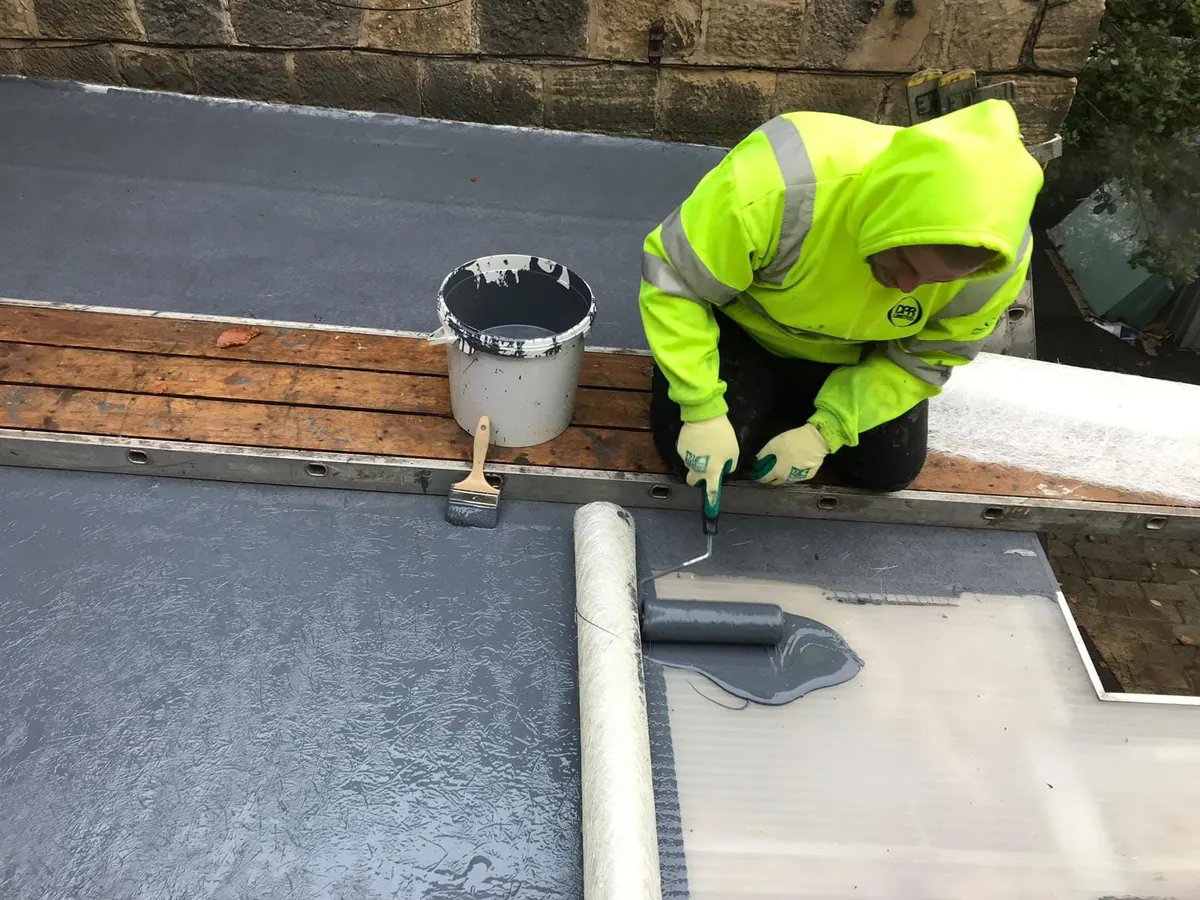
GRP is one of the most popular materials for flat roofs in the UK, but the name causes a lot of confusion. This guide explains what GRP is, how a GRP roof is built, and whether it’s the right choice for your roof.
What does GRP stand for?
GRP stands for glass reinforced plastic, sometimes written as glass reinforced polyester. It’s the same material as fibreglass. The two names are used interchangeably, so a “fibreglass roof” and a “GRP roof” are the same thing.
GRP is made from fine strands of glass, woven or chopped into a mat, set in a plastic resin. The glass gives it strength, and the resin binds it together and makes it waterproof. It’s the same material used for boat hulls, water tanks and car body panels.
How a GRP flat roof is built
A GRP roof is made on site, rather than rolled out in sheets. A typical installation goes like this:
- The deck. The old covering is stripped and a new timber deck is laid, usually OSB3 boards. A sound, dry deck is essential, as the GRP bonds directly to it.
- Edge trims. Pre-formed GRP trims are fixed around the edges of the roof, where it drains into the gutter, at walls and at the open sides.
- The laminate. Resin is rolled onto the deck, a glass fibre mat is laid into it, and more resin is rolled through until the mat is fully soaked. This is the waterproof layer.
- The topcoat. Once the laminate has cured, a coloured topcoat is applied to protect it from sunlight and give the final finish.
Because the whole roof is laminated in one go, there are no seams or joints for water to get through.
The pros of GRP roofing
- Seamless. The roof is one continuous layer, including the corners and upstands.
- Hard-wearing. A cured GRP roof is rigid and hard, so it copes well with light foot traffic, such as cleaning windows or maintaining equipment.
- Long-lasting. A well-installed GRP roof can last for decades, and some systems come with a material warranty of up to 20 years.
- Low maintenance. Beyond keeping it clear of leaves and debris, there’s little to do.
- Neat finish. It can be finished in different colours, and suits extensions, garages, dormers and balconies.
The cons of GRP roofing
- Weather-dependent. The resin needs dry conditions and the right temperature to cure, so GRP can’t be laid in rain or cold, damp weather.
- Relies on good workmanship. Mixing the resin, getting the right thickness of laminate and detailing the edges all take skill. A poorly laid GRP roof can crack or delaminate.
- Can crack if the deck moves. Because GRP is rigid, movement in a weak or wet deck can crack it, which is why a new deck is usually laid.
- Can be harder to repair invisibly. Repairs are possible, but patches may show in the topcoat.
GRP vs EPDM vs felt
| GRP | EPDM rubber | Felt | |
|---|---|---|---|
| What it is | Glass fibre and resin, laminated on site | A single sheet of synthetic rubber | Layers of bitumen felt, torched or bonded |
| Seams | None | Few or none on most domestic roofs | Overlapping joints |
| Feel | Hard and rigid | Flexible and soft | Firm, with a mineral finish |
| Foot traffic | Good | Fair, can be punctured | Fair |
| Typical uses | Extensions, dormers, balconies | Garages, extensions, larger roofs | Garages, sheds, older roofs |
EPDM is also a very good choice, and it copes better with a roof that moves. The right material depends on the roof’s size, shape, use and budget. Our guide to the best material for a flat roof goes into more detail.
Other uses for GRP on roofs
GRP isn’t just for flat roofs. It’s also used to:
- Line valleys and gutters. A GRP lining can renew an old lead valley or box gutter without the cost of new lead. See GRP: a low-cost alternative to lead.
- Encapsulate parapet coping stones, sealing the joints so water can’t get into the wall below. You can see an example in our ridge, slate and GRP coping project.
- Make rooflights. Translucent GRP sheets are used for rooflights on commercial buildings, like the 114 rooflights we replaced on a commercial roof.
GRP flat roofing in Leeds
We install and repair GRP, EPDM and liquid flat roofs across Leeds and West Yorkshire. New flat roofs generally come with a 10-year leak-free guarantee. You can see a new GRP flat roof on an industrial unit in our recent work, and find out more on our flat roofing page.
Call us on 0113 335 0043 or send us your details for a quote.